How to Use Exit Tickets for Real-Time Formative Assessment
You've just taught a lesson on solving two-step equations. It felt like it went well — students were nodding, a few answered questions correctly. But do you actually know whether most of the class understood? Waiting for next week's quiz to find out means a week of teaching built on a guess.
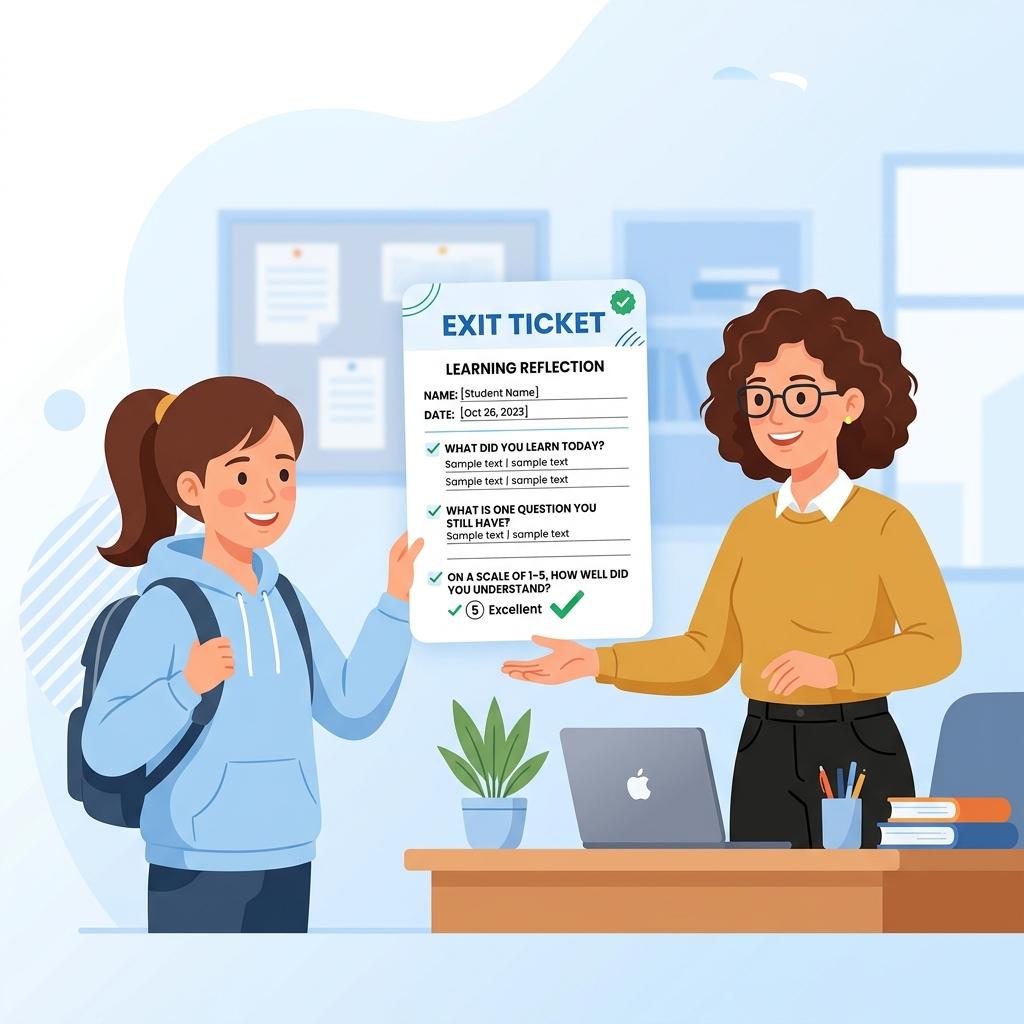
Exit tickets give you that information in the last few minutes of class. They're short, low-stakes questions students answer before leaving, and they're one of the simplest formative assessment tools available.
What exit tickets are for
An exit ticket is not a mini-test for the gradebook. Its purpose is to inform your teaching: to tell you, by the next lesson, whether to move on, reteach, or group students differently. That purpose shapes everything about how you design them.
Principle 1: Keep it short
One to three questions, completed in two or three minutes. Any longer and it becomes a quiz, takes time from the lesson, and gives you more to read than you can act on.
Principle 2: Align to today's objective
The question should test exactly what the lesson aimed to teach. If the objective was writing an equation from a word problem, the exit ticket should ask students to write an equation from a word problem — not to solve an unrelated equation.
Principle 3: Target likely errors
The most useful exit-ticket questions are designed to expose a specific misunderstanding. If you taught comma splices, ask students to fix one. If you taught subtracting negative numbers, include −5 − (−8), where the common error is easy to spot.
Types of exit tickets
Different formats give different information:
- A problem to solve: one or two questions that apply the skill.
- Explain it: "In one sentence, explain why we flip the inequality sign when we divide by a negative."
- 3-2-1: three things you learned, two questions you have, one thing you found difficult.
- Self-rating: a confidence scale (1–4) plus one question, to compare how students feel with how they perform.
- Muddiest point: "What was the most confusing part of today's lesson?"
Collecting exit tickets quickly
Paper slips are fast and reliable: students write on a half-sheet or sticky note and hand it over at the door. Digital forms are useful if your class already uses devices. Either way, keep the format consistent so it becomes routine.
Sorting them in minutes
The key to making exit tickets sustainable is to sort, not grade. Read through the stack and make three piles:
- Got it: ready to move on.
- Almost: small errors; a quick reminder will help.
- Not yet: needs reteaching.
This takes a few minutes for a class set, and it's enough to plan the next lesson.
Acting on the results
The value of an exit ticket comes from what happens next:
- If most students got it, move on and include a quick review question later in the week.
- If a group is "not yet," start the next lesson with a short reteach for that group while others do an extension task.
- If the whole class struggled, rethink your approach and try a different explanation or example.
- Share common mistakes with the class (anonymously) at the start of the next lesson.
Making exit tickets easy to prepare
Writing a well-targeted question every day takes some thought. A quiz generator can produce a few short questions on your lesson topic, with an answer key, in seconds — pick the one that best matches your objective. For more ideas on the bigger picture, see formative vs. summative assessment explained.
Used daily, exit tickets make sure you never move on while a group of students is left behind.
Not sure how long an exit ticket or quiz should be? See how many questions a quiz should have.
Ready to save time on your next worksheet?
Generate a worksheet