All posts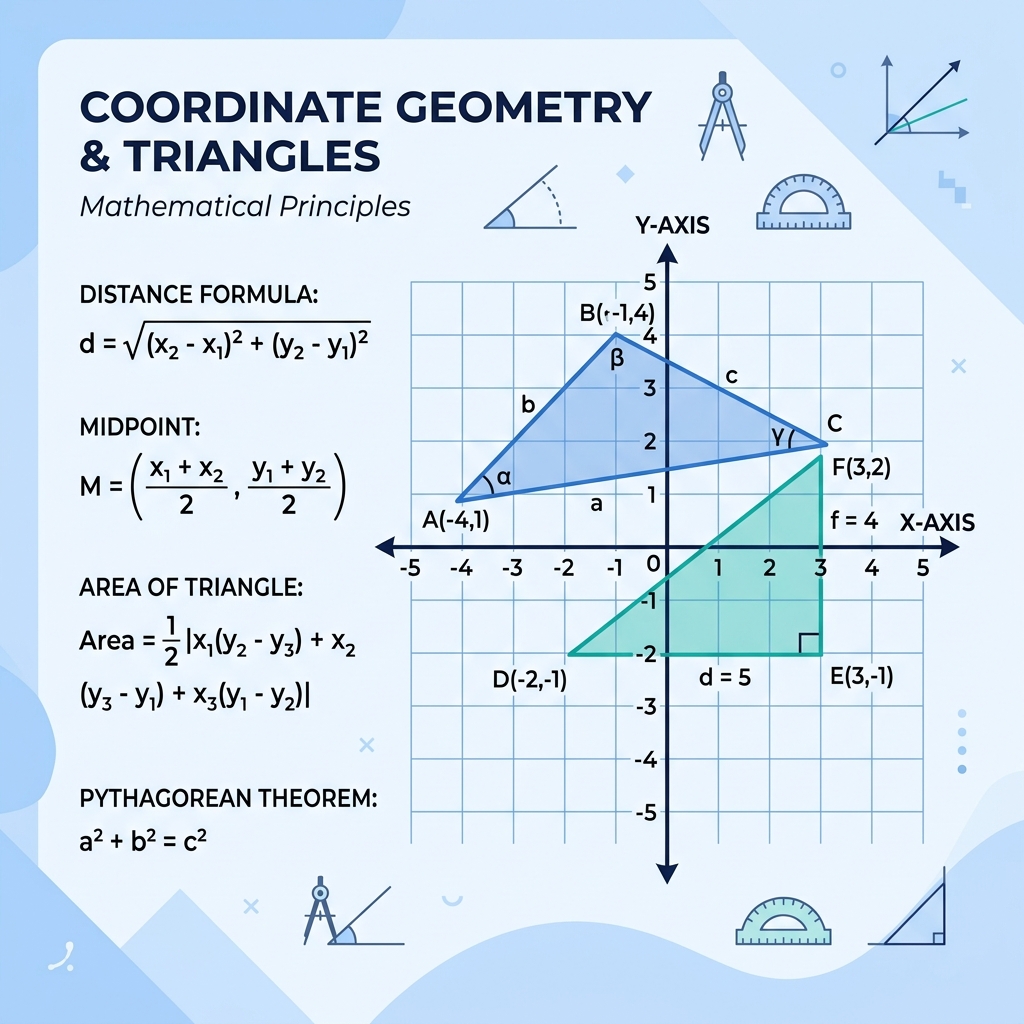
Lesson Prep6 min readJuly 2026
Using Visual Worksheets to Connect Algebra and Geometry Concepts
In secondary math education, algebra and geometry are often taught as separate subjects. Students study linear equations in one grade and coordinate geometry in another, rarely seeing how they connect. This separation makes it harder for them to build deep mathematical reasoning.
Using visual worksheets is an effective way to bridge this gap, helping students see the geometric meaning behind algebraic symbols.
Strategies for Integrating Concepts
- Visualizing Slope: Instead of just using the slope formula, have students graph lines on coordinate grids and count the rise and run. This connects algebraic slope values to geometric steepness.
- Geometric Algebra Models: Use algebra tiles or grid diagrams to model factoring and expansion. Visualizing (x + 2)(x + 3) as the area of a rectangle makes the FOIL method concrete.
- Coordinate Geometry Proofs: Use algebraic distance and midpoint formulas to prove geometric properties of shapes on a coordinate plane.
Designing worksheets that merge these concepts is easy when using a customized worksheet maker that supports coordinate grids and geometry diagrams.
By connecting algebra and geometry visually, you can help students build a cohesive understanding of mathematics.
Ready to save time on your next worksheet?
Generate a worksheet